
Achilles Pain in Tennis: The Morning Stiffness That Follows Hard Court Season
 Tennis
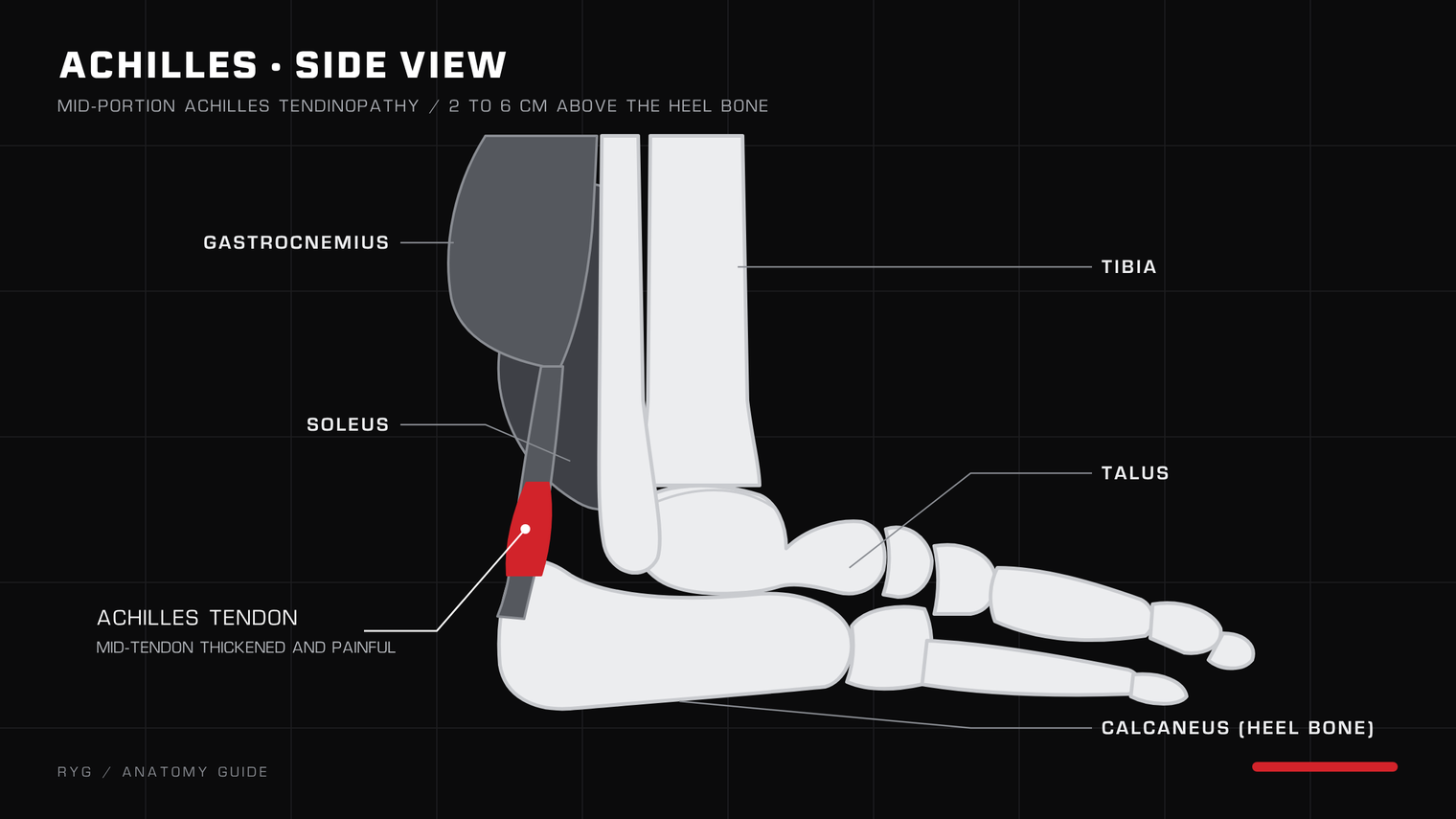
Your Achilles tendon is the strongest tendon in your body, and tennis treats it like it. Every split step landing, every explosive first step, every serve launch stores and releases energy through that cord like a spring. A hard court gives almost none of it back gently. When training volume climbs faster than the tendon adapts, it responds with Achilles tendinopathy, a tendon that has become disorganized and sensitive rather than torn.
The symptom pattern is so consistent you can nearly diagnose it from a text message. Stiff and sore for the first steps out of bed. Achy at the start of play, then warming up and quieting mid match, then sore again that evening. Tender to squeeze a few centimeters above the heel. That warm up effect fools players into pushing through for months, which is how a minor case becomes a stubborn one.
What's actually going on
A tendon adapts to load slowly, over weeks. A hard court season, a new league or a jump in match count adds load in days. The tendon responds by thickening, growing new blood vessels and becoming sensitive, and the calf muscle above it loses power. Two truths follow from that. Complete rest fails, because tendons detrain when unloaded and the pain returns the first week back. And the tendon rebuilds specifically in response to heavy, slow loading, one of the best supported findings in all of sports rehab.
What the research says
- About 1 in 20 recreational runners develops Achilles tendinopathy during a race build up, and having had Achilles pain in the previous 12 months raises the odds of a new episode more than 6 fold, the strongest risk factor identified1.
- Roughly a third of runners with a new episode of Achilles tendinopathy still have symptoms a year later, which is why early loading based rehab matters2.
- Athletes who kept running and jumping with pain monitored and capped at 5 out of 10 during rehab improved just as much at 12 months as those who stopped for 6 weeks, with no harm to the tendon3. The rule from that trial: pain should settle by the next morning and should not be getting worse week over week4.
- Heavy slow resistance training and eccentric heel drops give equally good results that last a year, but heavy slow resistance had 92% session adherence versus 78% and 100% patient satisfaction at 12 weeks versus 80%5. Twelve weeks of loading also reduced tendon thickness and abnormal blood vessel growth on imaging5.
- Exercise is the first line treatment for Achilles tendinopathy and should be given at least 3 months before other options are considered; recovery can take up to a year and recurrence is common during the return to sport phase6.
- The APTA JOSPT clinical practice guideline frames midportion Achilles tendinopathy around three findings: pain, stiffness, and calf muscle power deficits7.
- For a complete Achilles rupture, surgery lowers re rupture risk from 3.9% to 2.3% but raises complication risk from 1.6% to 4.9%, and with early motion functional rehab the re rupture difference disappears8.
What we do about it
Keep playing, by the rules. Tennis continues at a volume that keeps pain under 5 out of 10 and settled by the next morning. A small heel lift early can take the edge off. Overnight rest is not the plan; monitored load is.
Load heavy and slow. Calf raises with meaningful weight, both straight knee and bent knee, three sessions a week with a slow tempo, progressing the load every week or two. We choose the heavy slow version because adherence and satisfaction were better in the trial and the results were equal.
Make it a spring again. Pogo hops, then faster plyometrics, then explosive first steps and serve launches, because a tennis Achilles must eventually store and release energy, not just be strong. Expect a horizon of a few months, with steady progress rather than a single breakthrough, and a return phase that is watched closely because that is where recurrences cluster. This is the progression we run in the clinic, with a test at every phase before you move on.
When to get it looked at
- A sudden pop at the back of the ankle with weakness pushing off, which can be a rupture and needs same day assessment.
- Pain and tenderness at the heel bone itself rather than above it, which is a different version with a different plan.
- Swelling, warmth or redness around the tendon, or Achilles pain alongside a recent antibiotic course.
- Morning stiffness that has not improved after 12 weeks of consistent heavy slow loading.
Bottom line
Achilles tendinopathy is a tendon that fell behind the hard court schedule, and it catches up through heavy, slow, consistent loading while you keep playing within a pain rule. Rest does not rebuild it and the research on loading is as good as it gets. An in-person evaluation gives you the simplest possible way to tell whether your tendon is trending better or worse.
References
- Lagas IF, Fokkema T, Verhaar JAN, et al. Incidence of Achilles tendinopathy and associated risk factors in recreational runners: A large prospective cohort study. J Sci Med Sport. 2020;23(5):448-452. PubMed
- Lagas IF, Fokkema T, Bierma-Zeinstra SMA, et al. How many runners with new-onset Achilles tendinopathy develop persisting symptoms? A large prospective cohort study. Scand J Med Sci Sports. 2020;30(10):1939-1948. PubMed
- Silbernagel KG, Thomeé R, Eriksson BI, et al. Continued sports activity, using a pain-monitoring model, during rehabilitation in patients with Achilles tendinopathy: a randomized controlled study. Am J Sports Med. 2007;35(6):897-906. PubMed
- Silbernagel KG, Thomeé R, Eriksson BI, et al. Continued sports activity, using a pain-monitoring model, during rehabilitation in patients with Achilles tendinopathy: a randomized controlled study. Am J Sports Med. 2007;35(6):897-906. PubMed
- Beyer R, Kongsgaard M, Hougs Kjær B, et al. Heavy Slow Resistance Versus Eccentric Training as Treatment for Achilles Tendinopathy: A Randomized Controlled Trial. Am J Sports Med. 2015;43(7):1704-1711. PubMed
- Silbernagel KG, Crossley KM. A Proposed Return-to-Sport Program for Patients With Midportion Achilles Tendinopathy: Rationale and Implementation. J Orthop Sports Phys Ther. 2015;45(11):876-886. PubMed
- Martin RL, Chimenti R, Cuddeford T, et al. Achilles Pain, Stiffness, and Muscle Power Deficits: Midportion Achilles Tendinopathy Revision 2018. J Orthop Sports Phys Ther. 2018;48(5):A1-A38. PubMed
- Ochen Y, Beks RB, van Heijl M, et al. Operative treatment versus nonoperative treatment of Achilles tendon ruptures: systematic review and meta-analysis. BMJ. 2019;364:k5120. PubMed
Alex is awesome. He's responsive to ongoing issues, and he works to formulate a plan to help you achieve your end-goals.
I had been having calf issues for years that went misdiagnosed or undiagnosed through by other providers. Now, he's clearly properly diagnosed the issue and helped me implement a plan that has kept the issue from coming back. Highly recommend!
I'm a runner, and I came in with Achilles and hip pain. Alex worked with me to figure out how to rebalance my strength on both sides. Most importantly, he listened. Each time we met, he tailored my training plan based on my actual progress and how I was feeling about the various exercises. Each session felt meaningful and worth my time and money. If you are dealing with an injury that is holding you back from your fitness goals, I highly recommend Regain Your Game to get back on track and set a new standard for yourself.
This article is for education and does not replace an evaluation. If you're dealing with an active injury, see a licensed medical provider.