
Ankle Sprains in Tennis: The Most Common Injury on the Court, and the Most Undertreated
 Tennis
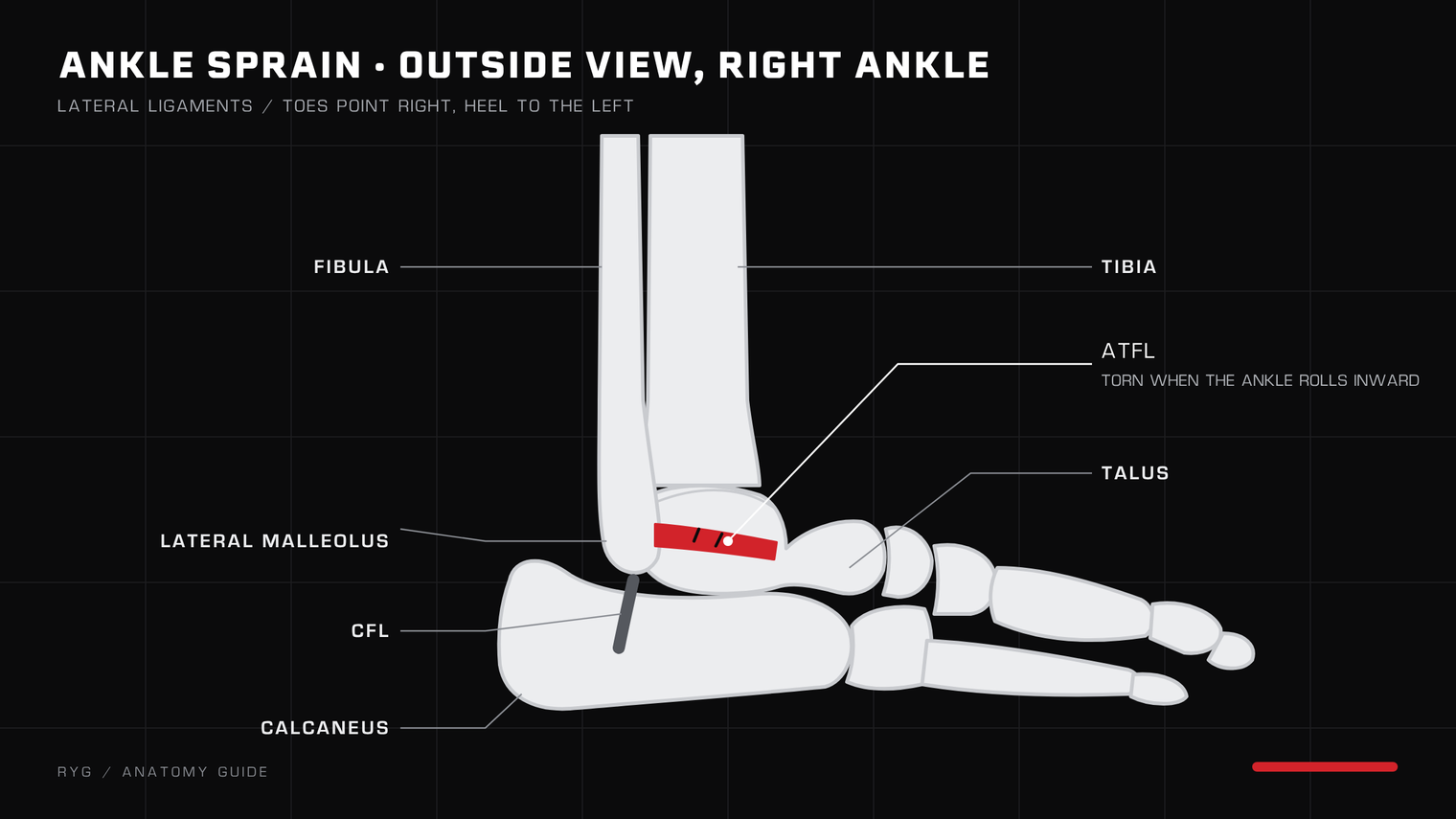
 is a lateral sport played on a grippy surface, which makes the ankle sprain its most common sudden injury. The mechanism is almost always the same: the foot plants to change direction, the shoe grips, and the body's momentum rolls the ankle outward over it. The ligaments on the outside of the ankle, with the ATFL in front taking the worst of it, get stretched or torn. Anyone who watched Alexander Zverev roll his ankle chasing a ball at Roland Garros and leave the court in a wheelchair has seen the worst case version of a mechanism that happens in milder form on club courts every day.
Here is the part that should change how you treat your next sprain. Sprains repeat, and chronic instability follows, not because the ankle is doomed but because most people never rehab them. The pain fades in one to three weeks, the swelling goes down, and they call it healed. The ligament may be healed. The system is not.
What's actually going on
Two things are quietly missing after every sprain. Balance, because the sprain damages the nerve endings in the ligament that tell your brain where your foot is in space. And strength, especially the peroneal muscles along the outside of the shin, which are your active defense against the next roll. Neither comes back on its own. Both come back quickly with training.
The early days matter too. The old advice of rest and ice has given way to protected movement, because a sprained ankle that moves early functions better and does not re injure more often.
What the research says
- Indoor and court sports carry the highest ankle sprain rate of any sport category, about 7 per 1,000 exposures, and female athletes sprain ankles at roughly twice the rate of males1.
- Under usual care, about 1 in 3 athletes re sprains the same ankle within a year; adding an 8 week home balance program cut that to 22%, a 35% reduction, and the benefit was greatest in athletes whose original sprain had not been medically treated2.
- Up to 40% of people who sprain an ankle for the first time develop chronic ankle instability: repeated sprains, giving way, and persistent pain, swelling or weakness more than a year after the injury3.
- After an ankle sprain, people who started exercise in the first week had better function at weeks 1 and 2 than those who rested, iced, compressed and elevated, with the same 4% reinjury rate4.
- Current guidelines favour a brace or tape plus a supervised exercise program over rest and passive treatments, with surgery reserved for sprains that fail thorough rehab5,6. Bracing has strong evidence and neuromuscular training moderate evidence for preventing a repeat sprain6.
- The severity of a sprain is judged most reliably by a hands on exam 4 to 5 days after injury, once the initial swelling has settled5. NSAIDs ease pain and swelling, but guidelines caution they may suppress the natural healing process5.
- Being unable to do a single leg drop landing or a drop jump 2 weeks after a first sprain predicts who will go on to chronic ankle instability7.
What we do about it
Days 1 to 5, protect and move. A brace or tape, compression, and weight bearing as tolerated from the first days. Ankle circles, alphabet tracing and calf pumps keep it moving. We re examine around day 4 or 5, when the exam actually tells us the grade.
Weeks 1 to 4, rebuild the system. Single leg balance progressing to unstable surfaces and eyes closed work, resisted strengthening in all directions with a bias toward the peroneals, and calf raises. The drop landing test at two weeks tells us who needs the longer version of the program.
Weeks 3 to 6, make it match speed. Hopping, landing and cutting drills that rebuild trust on the court, with a brace for the first weeks back on hard court because bracing is the best supported prevention tool we have. Most players come back more stable than before the injury. This is the progression we run in the clinic, with a test at every phase before you move on.
When to get it looked at
- Inability to bear weight for four steps, or bone tenderness at the back edge of either ankle bone, the base of the fifth metatarsal or the midfoot, which need an X-ray.
- A sprain with pain above the ankle that is worse with twisting, which can be a high ankle sprain and takes longer.
- Numbness, coldness or a foot that looks deformed.
- An ankle that is still swollen or giving way at four weeks, or a second sprain within a few months.
Bottom line
An ankle sprain is a ligament injury and a balance injury, and only one of those heals on its own. Early movement, a brace, and a few weeks of balance and strength work are what the evidence supports, and they cut the odds of the next sprain by a third. An in-person evaluation will show you whether your last sprain ever actually finished healing.
References
- Doherty C, Delahunt E, Caulfield B, et al. The incidence and prevalence of ankle sprain injury: a systematic review and meta-analysis of prospective epidemiological studies. Sports Med. 2014;44(1):123-140. PubMed
- Hupperets MD, Verhagen EA, van Mechelen W. Effect of unsupervised home based proprioceptive training on recurrences of ankle sprain: randomised controlled trial. BMJ. 2009;339:b2684. PubMed
- Hertel J, Corbett RO. An Updated Model of Chronic Ankle Instability. J Athl Train. 2019;54(6):572-588. PubMed
- Bleakley CM, O'Connor SR, Tully MA, et al. Effect of accelerated rehabilitation on function after ankle sprain: randomised controlled trial. BMJ. 2010;340:c1964. PubMed
- Vuurberg G, Hoorntje A, Wink LM, et al. Diagnosis, treatment and prevention of ankle sprains: update of an evidence-based clinical guideline. Br J Sports Med. 2018;52(15):956. PubMed
- Doherty C, Bleakley C, Delahunt E, et al. Treatment and prevention of acute and recurrent ankle sprain: an overview of systematic reviews with meta-analysis. Br J Sports Med. 2017;51(2):113-125. PubMed
- Doherty C, Bleakley C, Hertel J, et al. Recovery From a First-Time Lateral Ankle Sprain and the Predictors of Chronic Ankle Instability: A Prospective Cohort Analysis. Am J Sports Med. 2016;44(4):995-1003. PubMed
Had an amazing time this summer rehabbing my ankle with Dr. Shuchuk. He is very knowledgeable in any area of PT and always willing and able to help any ailment you have! I thought my ankle could never be fixed, but after getting on a plan and staying consistent I have regained my game!
Thanks Shu
Alex worked with our son on his ankle after a bad sprain and was able to help him strengthen his ankle to be back on the field in a shorter time frame. Alex was great at communication with our family and his coaching staff throughout the whole process. Definitely recommend.
This article is for education and does not replace an evaluation. If you're dealing with an active injury, see a licensed medical provider.