
Junior Tennis Tournament Schedules: How Much Is Too Much for a Growing Athlete?
 Tennis
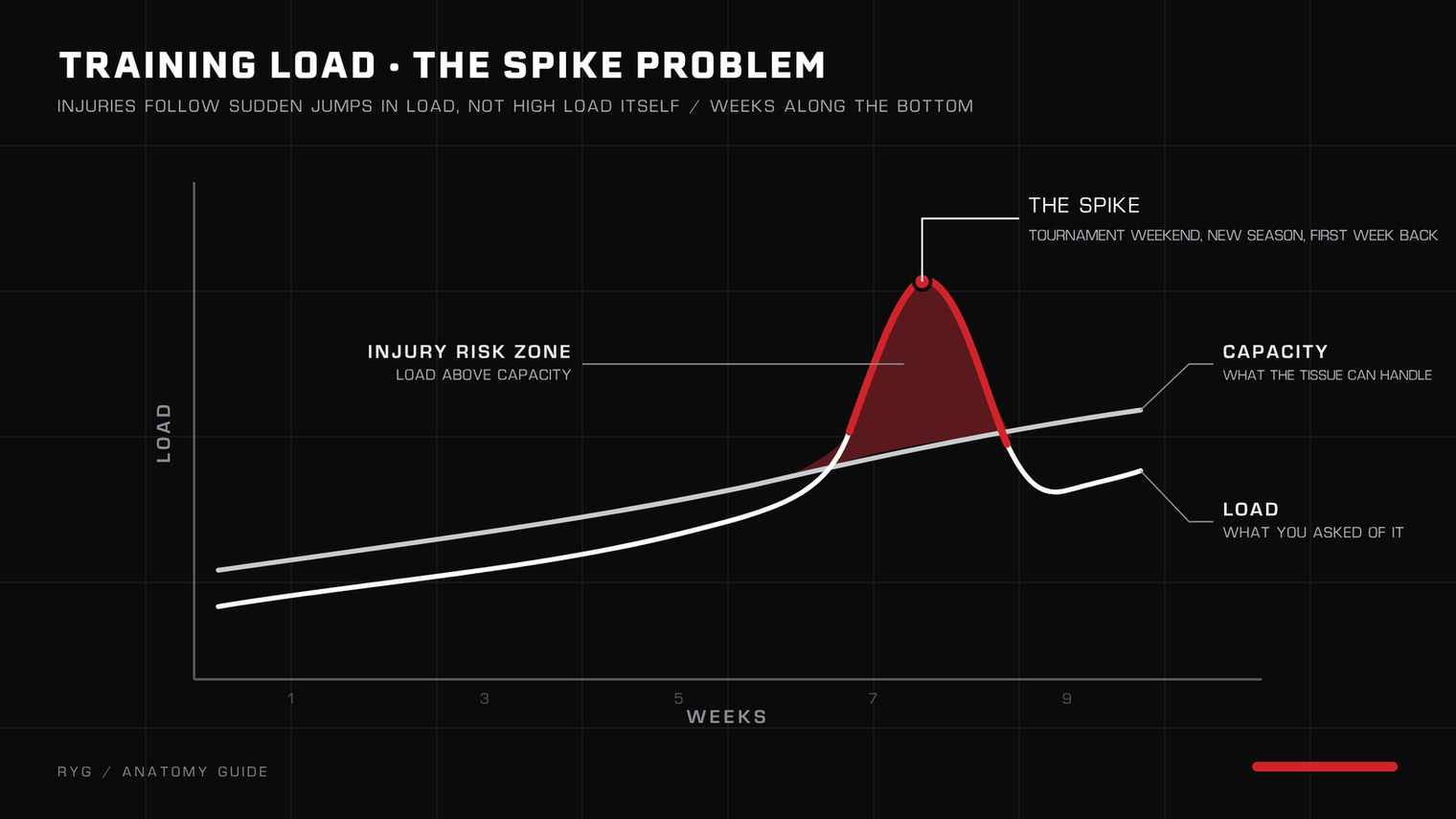
Most junior tennis injuries we see in the clinic were scheduled weeks before they happened. Not caused by one bad movement, but set up by a calendar: three tournaments in four weekends, five matches in two days, a jump from four to twelve hours of tennis the month school let out. Young bodies adapt to almost any load if it arrives gradually. What they cannot handle is the spike, and junior tennis calendars are built almost entirely out of spikes.
The tournament format is the quiet culprit. A regular training week might mean ninety minutes a day of varied practice. A tournament weekend can mean four or five matches of maximum intensity serving and sprinting compressed into two days, often after a taper week of light practice. That is the exact opposite of gradual.
What's actually going on
Growing bones are different from adult bones. During a growth spurt the growth plates and the bony attachments of tendons are the weakest links, which is why the same schedule an adult tolerates puts a 14 year old's back, elbow or knees at real risk. Overuse injuries are the result: repetitive stress without enough recovery, accumulating until something gives. Add short sleep, travel and the stress of ranking points and the body's repair budget shrinks further.
The research on youth workload is unusually consistent, and several of the strongest studies come from Wisconsin high school athletes.
What the research says
- Between 46% and 54% of all youth sports injuries are overuse injuries, not acute ones1. High school athletes who played a sport year round reported 42% more overuse injuries than those who played three seasons or fewer, and training more than 16 hours per week was linked to higher injury risk1.
- A young athlete who spends more hours per week in organized sport than their age in years has about twice the odds of a serious overuse injury, and kids whose organized sport time outweighs free play by more than 2 to 1 have 1.9 times the odds2.
- Among 1,544 Wisconsin high school athletes, high competition volume doubled the odds of a prior lower extremity injury and playing club sports raised it 1.5 times3. Highly specialized young athletes have 1.8 times the risk of an overuse injury compared with kids who play multiple sports4.
- Elite junior tennis players training about 9 hours a week had an overuse injury present in 12% of players during any given week of the season5.
- In adolescent soccer players, a spike in that day's training load roughly doubled the odds of injury, and worse mood that day was an independent predictor as well6.
- Tennis players were among the athletes who specialized earliest in a survey of 1,550 former NCAA athletes, and early specializers were no more likely to earn a scholarship but burned out at a higher rate, 10.5% versus 7.0%7.
- Adolescent athletes who averaged less than 8 hours of sleep a night were 1.7 times more likely to get injured than those who slept 8 or more8. Overtraining is a whole body problem: it lowers performance, raises injury and illness risk, and disrupts hormonal, neurologic and psychological systems9.
What we do about it
Set the guardrails. Keep total organized tennis hours per week at or below the athlete's age, which is the threshold the research identifies. Keep free play in the week. Protect at least one extended break from competition each year, and keep a second sport in the mix through the early teens if the athlete wants one.
Smooth the spikes. Build the schedule with recovery weekends between events rather than fixing it after a flare up. After a heavy tournament weekend, make the next two days truly light. Treat the first week after a school break or a big training camp as a ramp, not a launch. A simple weekly log of hours, matches, sleep and mood is the cheapest monitoring tool there is, and mood is a real predictor.
Watch the athlete, not just the calendar. Juniors underreport pain when tournaments are on the line, so parents need a different signal than asking does it hurt. Watch for a shorter serve motion, less sprinting to drop shots, rubbing an elbow or back between points, or a kid who suddenly stops hitting kick serves. Those are the moments to pull a match and get an opinion. None of this costs a ranking. Chronically sore players lose more points than rested ones ever do.
When to get it looked at
- Back pain in a 12 to 17 year old that has lasted more than two to three weeks, especially if it is worse with arching or serving.
- Elbow or shoulder pain in a junior that changes the serve, or pain at the growth plates of the knee or heel that is getting worse week to week.
- A limp, night pain, or any numbness or tingling.
- A player who is sleeping poorly, moody, and underperforming while training more, which is the overtraining pattern.
Bottom line
Junior tennis injuries track with scheduling more than with any single shot. The research gives parents concrete limits: hours per week under the athlete's age, no spikes, real recovery weekends, enough sleep, and some unstructured play. If you want an expert set of eyes on the season plan itself, an in-person evaluation helps you map tournaments and recovery on one page.
References
- DiFiori JP, Benjamin HJ, Brenner J, et al. Overuse injuries and burnout in youth sports: a position statement from the American Medical Society for Sports Medicine. Clin J Sport Med. 2014;24(1):3-20. PubMed
- Jayanthi NA, LaBella CR, Fischer D, et al. Sports-specialized intensive training and the risk of injury in young athletes: a clinical case-control study. Am J Sports Med. 2015;43(4):794-801. PubMed
- Post EG, Bell DR, Trigsted SM, et al. Association of Competition Volume, Club Sports, and Sport Specialization With Sex and Lower Extremity Injury History in High School Athletes. Sports Health. 2017;9(6):518-523. PubMed
- Bell DR, Post EG, Biese K, et al. Sport Specialization and Risk of Overuse Injuries: A Systematic Review With Meta-analysis. Pediatrics. 2018;142(3):e20180657. PubMed
- Pluim BM, Loeffen FG, Clarsen B, et al. A one-season prospective study of injuries and illness in elite junior tennis. Scand J Med Sci Sports. 2016;26(5):564-571. PubMed
- Watson A, Brickson S, Brooks A, et al. Subjective well-being and training load predict in-season injury and illness risk in female youth soccer players. Br J Sports Med. 2017;51(3):194-199. PubMed
- Rugg CM, Coughlan MJ, Li JN, et al. Early Sport Specialization Among Former National Collegiate Athletic Association Athletes: Trends, Scholarship Attainment, Injury, and Attrition. Am J Sports Med. 2021;49(4):1049-1058. PubMed
- Milewski MD, Skaggs DL, Bishop GA, et al. Chronic lack of sleep is associated with increased sports injuries in adolescent athletes. J Pediatr Orthop. 2014;34(2):129-133. PubMed
- Brenner JS, Watson A, Council on Sports Medicine and Fitness. Overuse Injuries, Overtraining, and Burnout in Young Athletes. Pediatrics. 2024;153(2):e2023065129. PubMed
This article is for education and does not replace an evaluation. If you're dealing with an active injury, see a licensed medical provider.