
Wrist Pain and the Modern Forehand: What Extreme Grips Ask of Your Wrist
 Tennis
The forehand your kid is learning is not the forehand you learned. Modern players use semi western and western grips, hands rotated further under the handle, to brush up the back of the ball for heavy topspin. It is a better shot, but it changes the math at the wrist. Those grips put the wrist into more extension and more ulnar deviation, bent back and tilted toward the pinky side, right at contact. The windshield wiper finish then whips the wrist through a huge arc at high speed, hundreds of times per practice.
Wrist trouble has become common enough at the top of the sport that it is almost a signature of the modern game. Juan Martin del Potro, owner of one of the biggest forehands ever, had his career interrupted repeatedly by wrist injuries. Volume plus extreme positions eventually finds the weak link.
What's actually going on
The structure that complains most is the ECU tendon, the extensor carpi ulnaris, which runs along the pinky side of your wrist inside a small tunnel and works overtime stabilizing those positions. With a western grip the wrist is loaded in exactly the direction that tendon has to resist. For most club and junior players the story is a pinky side ache during topspin forehands, sometimes a click, worse after long hitting sessions, better with a few days off, then right back when you play.
That cycle is the tendon telling you its capacity and your hitting volume do not match.
What the research says
- In 370 non professional tennis players, 13% reported a wrist injury, and the ECU tendon was involved in 30 of the 50 cases; the average time out of competition was 69 days1.
- The grip predicts where the wrist hurts: western and semi western grips went with pinky side injuries like ECU tendinopathy, while the eastern grip went with thumb side injuries like de Quervain's1.
- In that same study, body mass index, years of practice, weekly training hours, racket weight and strings made no difference to wrist injury, which points back to the grip and the position of the wrist at contact1.
- Hand and wrist injuries make up as much as 25% of all sports injuries, and in professional athletes only about 18% need surgery; most athletes get back to their previous performance2.
- A wrist MRI has to be read with care: in 103 people with no wrist pain, 39 wrists showed abnormalities of the TFCC cartilage and 23 looked like a complete tear, so imaging has to be matched to the exam and the story3.
- Among elite golfers, ECU tendon subluxation was the wrist injury that cost the most tournaments, a reminder that this tendon can slip out of its groove and needs a specific diagnosis when it clicks4.
What we do about it
Check the technique and the grip. A wrist that breaks down early in the swing, or a grip more extreme than your level requires, adds load without adding much spin. A small shift toward a less extreme grip is sometimes the whole fix for a club player.
Build the forearm. Resisted wrist extension, pinky side stability work with a light dumbbell or hammer handle, and forearm rotation control. We progress the load weekly so the tendon's capacity actually rises instead of just being rested.
Rebuild volume in steps. A gradual return to hitting rather than a straight jump back to two hour sessions. Flat balls first, then increasing topspin, then full practice. This is the progression we run in the clinic, with a test at every phase before you move on.
When to get it looked at
- A visible snap or the tendon slipping over the bone with forearm rotation.
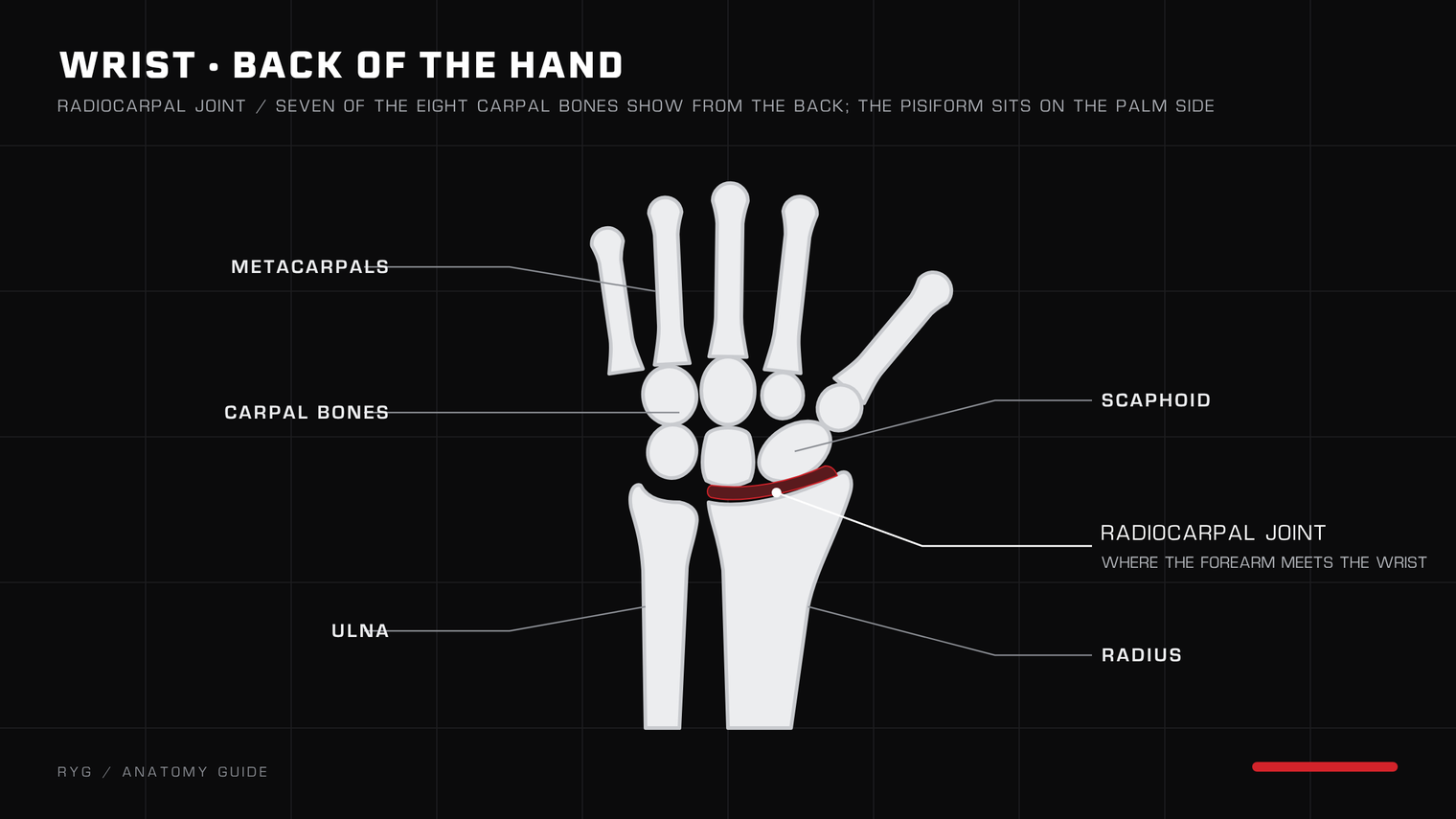
- Wrist pain after a fall on an outstretched hand, which needs a scaphoid check.
- Deep pinky side pain with a clunk, or pain pushing up out of a chair, which points toward the TFCC.
- Numbness, tingling or weakness in the hand.
- Wrist pain that has lasted more than four weeks despite reduced hitting.
Bottom line
The modern forehand is a better shot and a bigger ask of the wrist. The research ties pinky side pain to the western grip and to the ECU tendon more than to racket weight or strings, so the fix lives in technique, forearm strength and sensible volume. If you are not sure whether your pain is tendon or something deeper, an in-person evaluation is the place to start.
References
- Tagliafico AS, Ameri P, Michaud J, et al. Wrist injuries in nonprofessional tennis players: relationships with different grips. Am J Sports Med. 2009;37(4):760-767. PubMed
- Lehman JD, Krishnan KR, Stepan JG, et al. Prevalence and Treatment Outcomes of Hand and Wrist Injuries in Professional Athletes: A Systematic Review. HSS J. 2020;16(3):280-287. PubMed
- Iordache SD, Rowan R, Garvin GJ, et al. Prevalence of triangular fibrocartilage complex abnormalities on MRI scans of asymptomatic wrists. J Hand Surg Am. 2012;37(1):98-103. PubMed
- Hawkes R, O'Connor P, Campbell D. The prevalence, variety and impact of wrist problems in elite professional golfers on the European Tour. Br J Sports Med. 2013;47(17):1075-1079. PubMed
Alex is very approachable and makes you feel comfortable. Wrote me a program to rehab my broken wrist that I had surgery on. You can tell he truly cares and takes his profession seriously.
This article is for education and does not replace an evaluation. If you're dealing with an active injury, see a licensed medical provider.