
Achilles Tendon Pain in Volleyball: The Morning Stiffness That Warms Up and Comes Back
 Volleyball
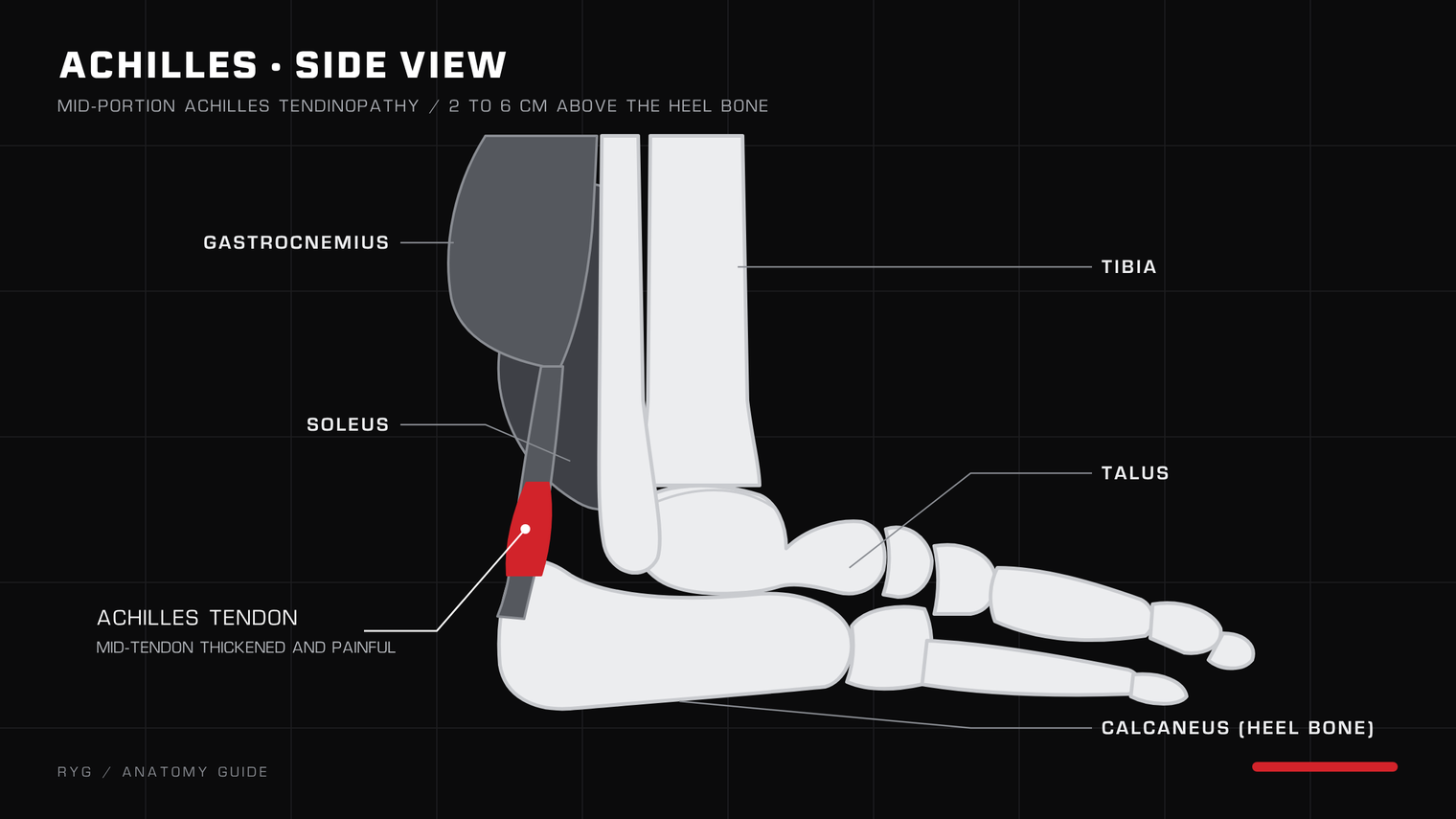
Achilles pain follows a pattern so consistent we can usually describe it before the athlete does. Stiff and sore with the first steps out of bed, achy at the start of warmup, then it quiets down during play, only to ache again that evening and be stiff again the next morning. That warm-up phenomenon is the signature of Achilles tendinopathy, an overload condition of the biggest tendon in the body, and volleyball's jump count makes it a regular visitor.
The instinct is to rest it until the morning stiffness goes away. The research on this tendon says that instinct is wrong, and it says so with unusually good trials.
What's actually going on
The Achilles stores energy like a spring on every takeoff and landing, stretching and recoiling with forces several times body weight. When jump volume rises faster than the tendon can adapt, the collagen structure in a section of the tendon gets disorganized. A disorganized tendon is less springy and more sensitive, but it is not inflamed the way a fresh injury is, which is why anti-inflammatories and ice give brief relief at best. The morning stiffness is the tendon's sensitivity after hours of no load. Warming up loads it and it calms, then it overloads and aches again. Rest lowers the sensitivity, but a rested tendon has not been rebuilt, so the pain returns when the jumping does.
What the research says
- Having had Achilles pain in the previous 12 months raised the odds of a new episode more than 6-fold in a cohort of 1,929 runners, the strongest risk factor identified1.
- Roughly a third of runners with a new episode of Achilles tendinopathy still had symptoms a year later, which is why early loading-based rehab matters2.
- Athletes who kept running and jumping with pain monitored and capped during rehab improved just as much at 12 months as those who stopped for 6 weeks, with no harm to the tendon3.
- The pain-monitoring rule from that trial: pain up to 5 out of 10 during and after exercise is acceptable, it should settle by the next morning, and it should not be getting worse week over week4.
- Heavy slow resistance training and eccentric heel drops gave equally good results that lasted a year, but heavy slow resistance had 92% session adherence versus 78% and 100% patient satisfaction at 12 weeks versus 80%; twelve weeks of loading also reduced tendon thickness and abnormal blood vessel growth on imaging5.
- Exercise is the first-line treatment and should be given at least 3 months before other options are considered; recovery can take up to a year and recurrence is common, especially during the return-to-sport phase6.
The clinical practice guideline frames the condition around three findings: pain, stiffness and calf muscle power deficits, and that last one is the piece most players have never addressed7.
What we do about it
The rehab evidence is strong and specific. Early on, isometric calf holds settle pain and let the athlete keep training within the pain-monitoring rule rather than stopping. We set the volleyball volume so pain stays under the cap and settles by morning.
The core of the program is heavy, slow calf work: raises and lowers with real weight, straight-knee and bent-knee, done consistently over weeks. This is what remodels the tendon's structure and restores its spring, and it is why we test calf strength and single-leg raise capacity at the start and track it. The research says heavy slow resistance and eccentric programs work equally well, and athletes stick with the heavy slow version better, so that is what we use.
Later, the program must progress into fast, springy loading, skipping, hopping and jumping, because volleyball uses the tendon as a spring, not just a rope. Skipping that stage is the most common reason the pain comes back when full jump volume resumes. Players in This is the progression we run in the clinic, with a test at every phase before you move on.
When to get it looked at
- A sudden pop in the back of the ankle with inability to rise onto the toes or push off, which can mean a rupture.
- Achilles pain in a growing athlete that sits on the heel bone itself rather than the tendon.
- A tendon that is red, hot or swollen along its length rather than just thickened and sore.
- Pain that is now present with walking or at rest, not just with jumping.
- Morning stiffness and pain that have lasted more than a month despite reducing jump volume.
Bottom line
The Achilles that is stiff in the morning and warms up during play is a tendon that needs to be rebuilt, not rested. The trials show athletes can keep jumping within a pain cap while they do heavy slow calf work, that the gains last a year, and that a third of untreated cases are still sore a year later. The springy loading at the end is what makes it hold. If there was a pop, get it seen today. Otherwise book an evaluation, in person, and start the loading program.
References
- Lagas IF, Fokkema T, Verhaar JAN, et al. Incidence of Achilles tendinopathy and associated risk factors in recreational runners: A large prospective cohort study. J Sci Med Sport. 2020;23(5):448-452. PubMed
- Lagas IF, Fokkema T, Bierma-Zeinstra SMA, et al. How many runners with new-onset Achilles tendinopathy develop persisting symptoms? A large prospective cohort study. Scand J Med Sci Sports. 2020;30(10):1939-1948. PubMed
- Silbernagel KG, Thomeé R, Eriksson BI, et al. Continued sports activity, using a pain-monitoring model, during rehabilitation in patients with Achilles tendinopathy: a randomized controlled study. Am J Sports Med. 2007;35(6):897-906. PubMed
- Silbernagel KG, Thomeé R, Eriksson BI, et al. Continued sports activity, using a pain-monitoring model, during rehabilitation in patients with Achilles tendinopathy: a randomized controlled study. Am J Sports Med. 2007;35(6):897-906. PubMed
- Beyer R, Kongsgaard M, Hougs Kjær B, et al. Heavy Slow Resistance Versus Eccentric Training as Treatment for Achilles Tendinopathy: A Randomized Controlled Trial. Am J Sports Med. 2015;43(7):1704-1711. PubMed
- Silbernagel KG, Crossley KM. A Proposed Return-to-Sport Program for Patients With Midportion Achilles Tendinopathy: Rationale and Implementation. J Orthop Sports Phys Ther. 2015;45(11):876-886. PubMed
- Martin RL, Chimenti R, Cuddeford T, et al. Achilles Pain, Stiffness, and Muscle Power Deficits: Midportion Achilles Tendinopathy Revision 2018. J Orthop Sports Phys Ther. 2018;48(5):A1-A38. PubMed
Alex does amazing work and had me feeling better in no time! I had alot of tightness in my hamstrings and calves and used needles and a lot of soft tissue work to loosen them up!
Alex is awesome. He's responsive to ongoing issues, and he works to formulate a plan to help you achieve your end-goals.
I had been having calf issues for years that went misdiagnosed or undiagnosed through by other providers. Now, he's clearly properly diagnosed the issue and helped me implement a plan that has kept the issue from coming back. Highly recommend!
This article is for education and does not replace an evaluation. If you're dealing with an active injury, see a licensed medical provider.