
Volleyball Ankle Sprains: What Happens When You Land on Another Player's Foot
 Volleyball
Ask any volleyball player how they sprained their ankle and you will usually hear the same story. They went up to block or hit, came down at the net, and landed on a teammate's or opponent's foot. The ankle rolled inward, there might have been a pop, and the outside of the ankle swelled up by that evening. Ankle sprains are the signature acute injury of the sport, and the crowded space under the net is why.
What happens in the first two weeks after that roll decides, more than the sprain itself, whether this is a one-time event or the start of an ankle that keeps giving way.
What's actually going on
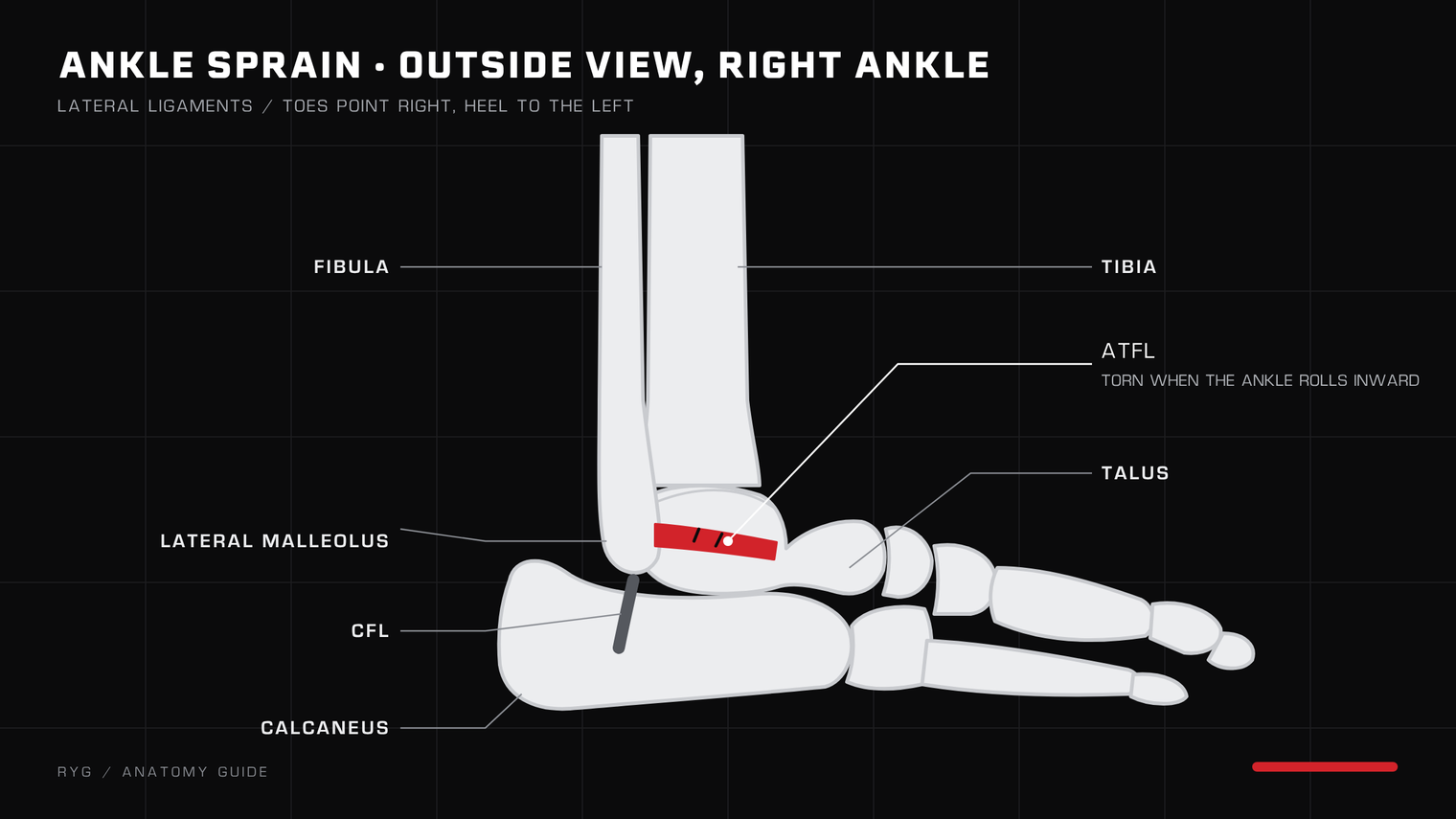
What actually tears are the ligaments on the outside of the ankle, small straps of tissue that check the rolling motion. The ligament heals over weeks. But two other things do not come back on their own: balance and reaction. Those ligaments are packed with position sensors that tell your brain where your foot is in space, and a sprain scrambles that signal. So the next time the foot lands slightly rolled, the split-second correction arrives late. The muscles on the outside of the lower leg, the peroneals, also get weak and slow while the ankle is sore. That combination, a loose ligament plus blurry sensors plus slow muscles, is the recipe for the second sprain.
What the research says
- Indoor and court sports carry the highest ankle sprain rate of any sport category, about 7 per 1,000 exposures, and female athletes sprain ankles at roughly twice the rate of males1.
- Under usual care, about 1 in 3 athletes re-sprained the same ankle within a year; adding an 8-week home balance program cut that to 22%, a 35% reduction, with the biggest benefit in athletes whose original sprain had not been medically treated2.
- Current guidelines favor a brace or tape plus a supervised exercise program over rest and passive treatments, with surgery reserved for sprains that fail thorough rehab; the severity of a sprain is judged most reliably by a hands-on exam 4 to 5 days after injury once swelling settles3.
- Across 46 systematic reviews, bracing has strong evidence and neuromuscular training moderate evidence for preventing a repeat sprain, and early mobilization has strong evidence for recovery after the acute injury4.
- People who started exercise in the first week after a sprain had better function at weeks 1 and 2 than those who rested, iced, compressed and elevated, with the same 4% reinjury rate5.
- Being unable to do a single-leg drop landing or a drop jump 2 weeks after a first sprain predicted who would go on to chronic ankle instability6.
The clinical practice guideline gives its strongest grade to progressive weight bearing and structured exercise and only a low grade to ice, and about 40% of first-time sprains progress to chronic instability, which is why exercise-based rehab, not rest, is recommended7.
What we do about it
First few days: protect it with a brace or tape, get the swelling moving with elevation and gentle motion, and start walking as tolerated, because early movement beats strict rest. If you cannot bear weight at all or there is bone tenderness, get an X-ray. We do the hands-on severity exam around day 4 or 5 when the swelling allows an honest assessment.
After the early phase, the real work. Calf and peroneal strengthening, then single-leg balance that gets progressively harder: eyes closed, on foam, while catching a ball. Then the reactive layer: hopping with direction changes, landing with a nudge, and jump-and-land drills near a line to simulate the net, because the sensors have to be retrained under volleyball conditions. We test the single-leg landing and drop jump at two weeks, since failing them is a warning sign.
Return to play is criteria-based: hop tests, balance reach and strength symmetry. A brace during the return window is sensible, and for many players through the rest of the season, given the evidence. Players in This is the progression we run in the clinic, with a test at every phase before you move on.
When to get it looked at
- Inability to bear weight for four steps right after the injury or in the first days.
- Tenderness on the bone at the back edge of either ankle bone, or on the outside of the midfoot, which are X-ray triggers.
- Numbness, coldness or a foot that looks deformed.
- Pain above the ankle between the shin bones that is worse with twisting, which can mean a high ankle sprain.
- An ankle that is still swollen, weak or giving way after two to three weeks.
Bottom line
The volleyball ankle sprain is a landing-on-a-foot injury, and the research is clear that early movement plus a structured balance and strength program, not rest and ice, is what gets it back and keeps it from happening again. A third of untreated sprains repeat within a year; a few weeks of balance training cuts that sharply. Get the X-ray signs checked if they are present. Otherwise book an evaluation, in person, within the first week.
References
- Doherty C, Delahunt E, Caulfield B, et al. The incidence and prevalence of ankle sprain injury: a systematic review and meta-analysis of prospective epidemiological studies. Sports Med. 2014;44(1):123-140. PubMed
- Hupperets MD, Verhagen EA, van Mechelen W. Effect of unsupervised home based proprioceptive training on recurrences of ankle sprain: randomised controlled trial. BMJ. 2009;339:b2684. PubMed
- Vuurberg G, Hoorntje A, Wink LM, et al. Diagnosis, treatment and prevention of ankle sprains: update of an evidence-based clinical guideline. Br J Sports Med. 2018;52(15):956. PubMed
- Doherty C, Bleakley C, Delahunt E, et al. Treatment and prevention of acute and recurrent ankle sprain: an overview of systematic reviews with meta-analysis. Br J Sports Med. 2017;51(2):113-125. PubMed
- Bleakley CM, O'Connor SR, Tully MA, et al. Effect of accelerated rehabilitation on function after ankle sprain: randomised controlled trial. BMJ. 2010;340:c1964. PubMed
- Doherty C, Bleakley C, Hertel J, et al. Recovery From a First-Time Lateral Ankle Sprain and the Predictors of Chronic Ankle Instability: A Prospective Cohort Analysis. Am J Sports Med. 2016;44(4):995-1003. PubMed
- Martin RL, Davenport TE, Fraser JJ, et al. Ankle Stability and Movement Coordination Impairments: Lateral Ankle Ligament Sprains Revision 2021. J Orthop Sports Phys Ther. 2021;51(4):CPG1-CPG80. PubMed
Had an amazing time this summer rehabbing my ankle with Dr. Shuchuk. He is very knowledgeable in any area of PT and always willing and able to help any ailment you have! I thought my ankle could never be fixed, but after getting on a plan and staying consistent I have regained my game!
Thanks Shu
Alex worked with our son on his ankle after a bad sprain and was able to help him strengthen his ankle to be back on the field in a shorter time frame. Alex was great at communication with our family and his coaching staff throughout the whole process. Definitely recommend.
This article is for education and does not replace an evaluation. If you're dealing with an active injury, see a licensed medical provider.