
Wrist Pain in Volleyball: Why Setters and Blockers Get It and How to Calm It Down
 Volleyball
Wrist pain in volleyball tends to come in two flavors. The first is the slow kind, an ache along the back or thumb side of the wrist that builds over weeks of setting, passing and hitting reps. The second is the sudden kind, a blocked ball or a floor dig that bends the wrist backward hard and leaves it sore for days. Both are common, and both get shrugged off far too long because the wrist seems minor compared with a knee or a shoulder.
The research on hand and wrist injuries in sport says two things clearly. Most of them do not need surgery, and the ones that get missed are the ones that cause lasting trouble.
What's actually going on
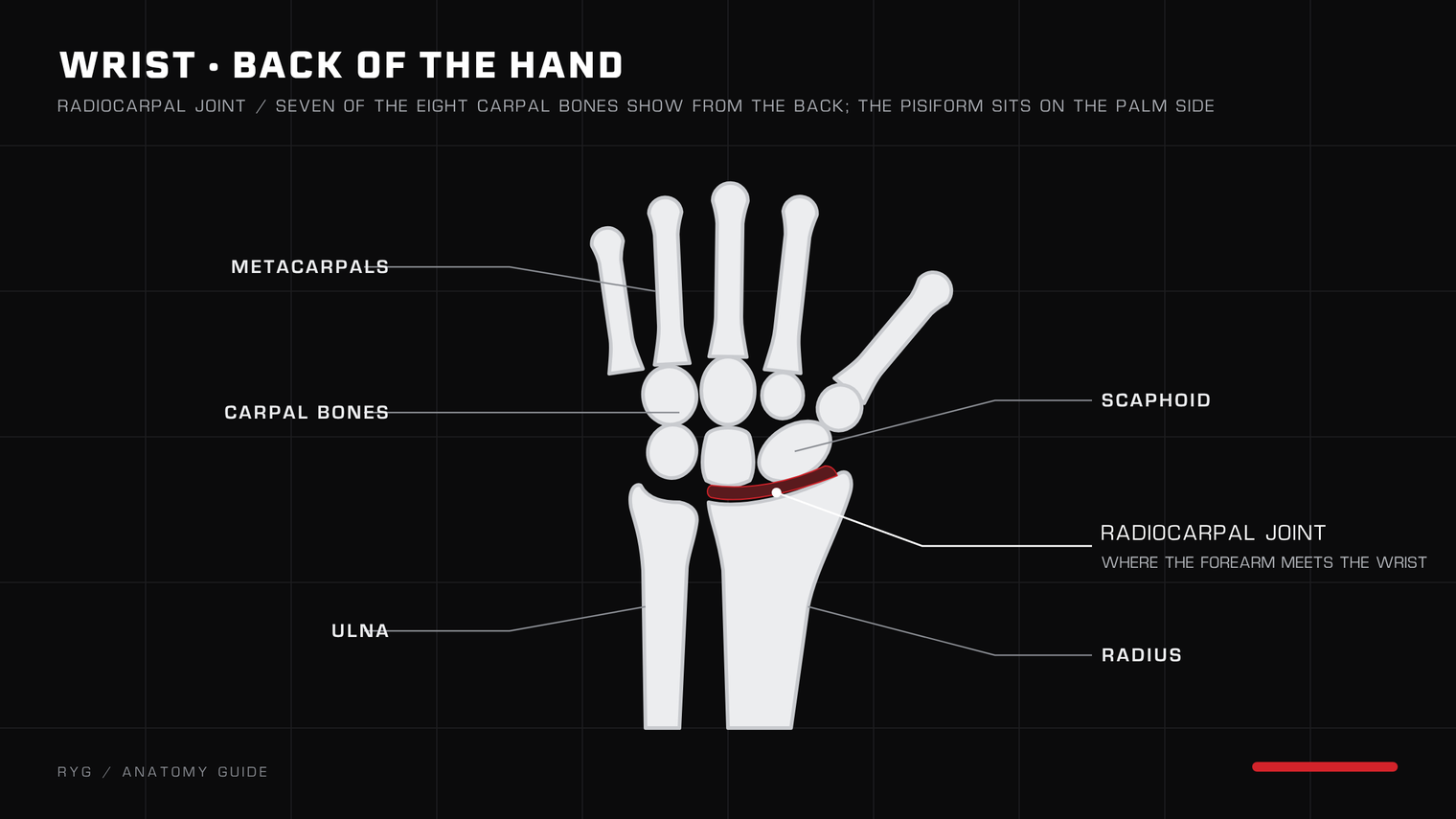
The slow kind has a workload explanation. Every set loads the wrist in extension, bent backward, with the fingers absorbing the ball's force. Setters can take hundreds of contacts a day, and the small tendons crossing the wrist get irritated when volume jumps quickly, the same overuse math as any tendon problem. The sudden kind is a sprain, stretched ligaments from a forced bend, usually from a blocked ball driving the hand back or a dive onto an outstretched hand. Most sprains settle. The concern with a fall on an outstretched hand is the scaphoid, a small bone on the thumb side of the wrist with a poor blood supply, which can fracture quietly and fail to heal if it is played on.
What the research says
- Hand and wrist injuries account for up to 25% of all sports injuries. In professional athletes only about 18% needed surgery, average return to play was 2.8 months, and most athletes got back to their previous performance1.
- The scaphoid is the wrist bone to worry about after a fall on an outstretched hand. It accounts for over 85% of sport-related wrist bone fractures2.
- Scaphoid fractures treated in a cast healed in 85% of cases over about 14 weeks, while screw fixation healed 97% in about 10 weeks and got athletes back roughly 2 weeks sooner; returning to play immediately in a cast carried a significant risk of the bone not healing2.
- The tendons on the little-finger side of the wrist are a common overuse site in racket sports, where the extensor carpi ulnaris was involved in 30 of 50 reported wrist injuries and average time out of competition was 69 days3.
- In elite golfers, many minor wrist problems were managed by adjusting technique or practice volume so the athlete kept playing while recovering, while structural injuries needed a specific treatment plan and time away4.
We should be honest about the limits here. There is very little research specific to volleyball wrists. The principles above come from other sports, and they transfer: diagnose the sudden injuries properly, manage the overuse ones with load.
What we do about it
For the sudden kind, the first job is ruling out a fracture. Tenderness in the small hollow at the base of the thumb after a fall gets an X-ray, and sometimes a repeat X-ray or further imaging if the first one is clean but the tenderness persists, because scaphoid fractures hide. A true sprain gets a short period of protection with a brace or tape, then early motion, grip and wrist strengthening, and a graded return to setting and digging.
For the slow kind, we trace the volume. A jump in setting reps, a new ball, a position change or a tournament weekend usually explains the timing. We trim the spike in volume rather than stopping, calm the irritated tendon, then build the wrist's capacity with wrist curls and extensions, pronation and supination with a light dumbbell, grip work and finger extensor training. Then set and pass volume is rebuilt in steps. Players in This is the progression we run in the clinic, with a test at every phase before you move on.
When to get it looked at
- Tenderness at the base of the thumb after a fall on an outstretched hand, even if the X-ray looked normal.
- A wrist that is visibly deformed, or cannot bear weight or grip.
- Clicking, catching or a feeling of the wrist giving way.
- Numbness or tingling in the fingers.
- An overuse ache that has lasted more than three weeks despite reducing reps.
Bottom line
Most volleyball wrist pain is either an overloaded tendon or a sprain, and most of both resolve with load management and strengthening rather than surgery. The exception that matters is the scaphoid after a fall, which needs a proper exam and imaging rather than tape and a shrug. Playing through a wrist problem for months turns a short fix into a long one. If it has lingered, get it assessed, in person.
References
- Lehman JD, Krishnan KR, Stepan JG, et al. Prevalence and Treatment Outcomes of Hand and Wrist Injuries in Professional Athletes: A Systematic Review. HSS J. 2020;16(3):280-287. PubMed
- Goffin JS, Liao Q, Robertson GA. Return to sport following scaphoid fractures: A systematic review and meta-analysis. World J Orthop. 2019;10(2):101-114. PubMed
- Tagliafico AS, Ameri P, Michaud J, et al. Wrist injuries in nonprofessional tennis players: relationships with different grips. Am J Sports Med. 2009;37(4):760-767. PubMed
- Hawkes R, O'Connor P, Campbell D. The prevalence, variety and impact of wrist problems in elite professional golfers on the European Tour. Br J Sports Med. 2013;47(17):1075-1079. PubMed
Alex is very approachable and makes you feel comfortable. Wrote me a program to rehab my broken wrist that I had surgery on. You can tell he truly cares and takes his profession seriously.
This article is for education and does not replace an evaluation. If you're dealing with an active injury, see a licensed medical provider.