
Turf Toe in Basketball: The Small Joint Injury That Steals Your Push Off
 Basketball
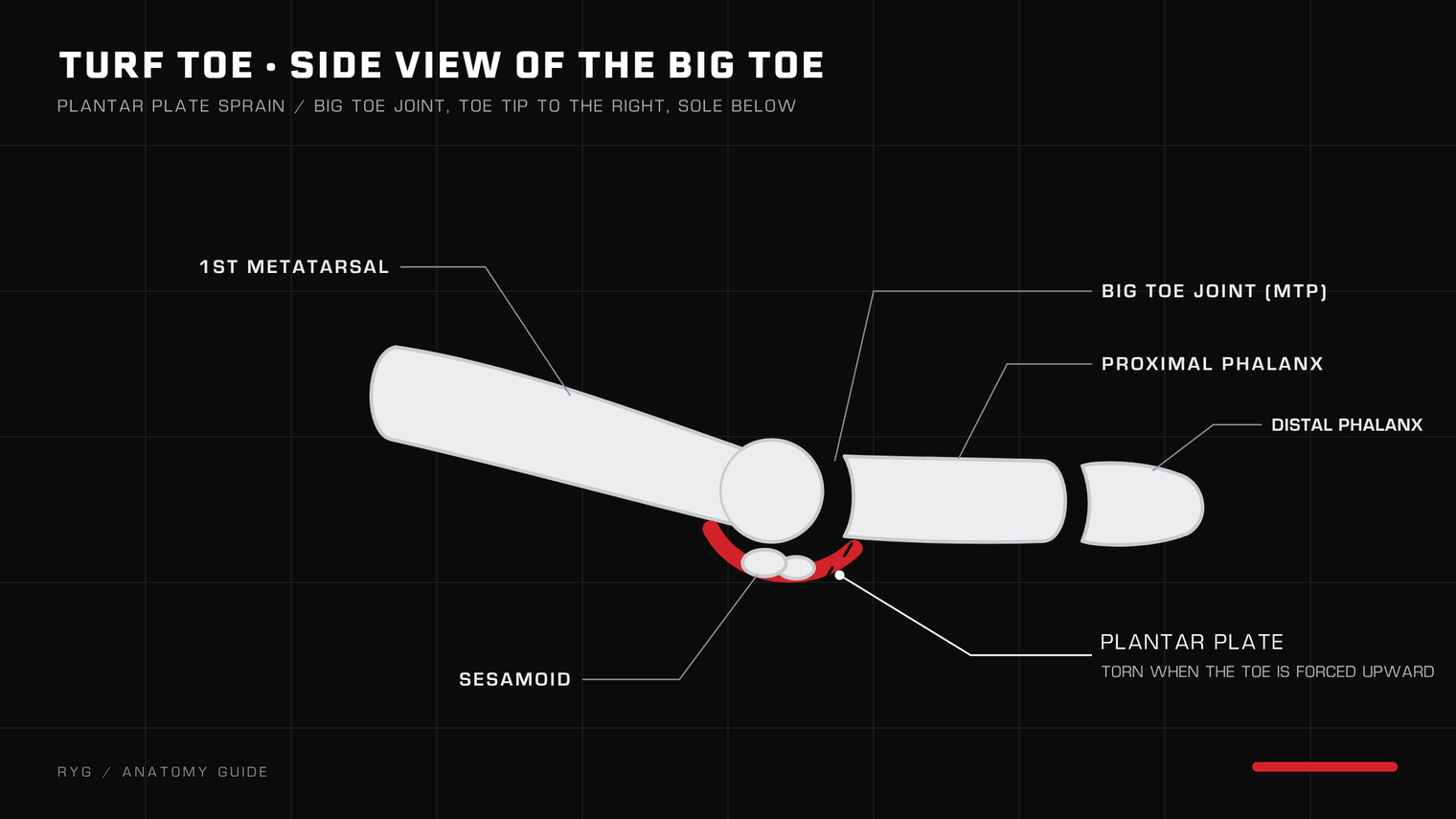
Turf toe sounds like a football problem, but basketball courts produce plenty of it. The injury is a sprain of the ligaments under your big toe joint, usually from the toe being bent backward past its limit: jamming into the floor on a jump stop, getting caught under you in a pileup, or an awkward push-off where the toe stays planted as your body drives forward. Modern basketball shoes with flexible forefeet make the sport quicker, but they also leave that joint less protected than old stiff-soled shoes did.
What's actually going on
Why does such a small joint matter so much? Because your big toe is the last thing touching the ground on every sprint stride and jump takeoff. At push-off, that joint bends sharply while transmitting a huge share of your propulsion. The structures under the joint, a little complex of ligaments and two small bones called sesamoids, are what let you load it that hard. Sprain them and the body immediately stops trusting the toe, so players push off the outside of the foot instead, lose their first step and their vertical, and often pick up secondary aches from the compensation.
What the research says
- Turf toe is a hyperextension injury of the big toe joint in 85% of cases, and in the original professional football series 83% of players were first injured on artificial turf1.
- In college football, turf toe happens at 0.062 per 1,000 athlete-exposures, nearly 14 times more often in games than practice, and costs an average of 10 days2.
- Fewer than 2% of turf toe injuries need surgery; the rest are managed with protection, taping and a graded return2.
- Recovery depends on grade: a grade I sprain returns as tolerated, a grade II partial tear takes about 2 weeks, and a grade III complete tear needs at least 10 to 16 weeks3.
- Football players who needed surgical repair of a complete turf toe injury missed an average of 16.5 weeks but had excellent outcomes about 2 years later, with pain under 1 out of 104.
- A past turf toe leaves the big toe joint with about 8 degrees less dorsiflexion (40.6 vs 48.4 degrees) and higher peak pressure under the toe, which is why restoring motion and push-off strength matters5.
- NFL players who returned from turf toe performed at the same level as uninjured peers over the next 2 seasons, even though the injury cost an average of 5 weeks6.
What we do about it
Severity drives the timeline, and this is the injury where patience pays most. Grading on exam comes first, because a grade I and a grade III are different injuries with different calendars. The trap is that walking often feels fine early, so players return fast, then the joint gets re-jammed and a two-week injury becomes a two-month one. The test that matters is pain-free push-off at full effort, not comfortable walking.
Good rehab protects the joint early, often with a stiff-soled shoe or insert and a taping technique that limits the toe bending back. Then it gradually restores the toe's bend, because the research says a past turf toe leaves the joint stiffer and more loaded for years if motion is not rebuilt. Then it strengthens the foot and rebuilds push-off through calf raises, marching, and finally jumps and sprints, with a graded return to full-effort takeoffs. For a complete tear, we plan for the long road and coordinate with a surgeon, knowing the outcomes after repair are good. This is the progression we run in the clinic, with a test at every phase before you move on.
When to get it looked at
- A pop at the big toe with immediate swelling and bruising, or an inability to push off at all.
- A big toe that bends backward much further than the other side, or feels unstable.
- Pain under the ball of the foot that has not settled after two weeks of protection.
- Numbness in the toe.
- Big toe joint pain in an older player that is stiff rather than sprained, since arthritis of that joint is a separate cause7.
Bottom line
Turf toe is small, common, and rarely surgical, but it is the injury that most punishes an early return. Grade it, protect it, rebuild the bend and the push-off, and test full-effort takeoff before you trust it. An in-person evaluation can help you judge how serious your toe actually is.
References
- Rodeo SA, O'Brien S, Warren RF, et al. Turf-toe: an analysis of metatarsophalangeal joint sprains in professional football players. Am J Sports Med. 1990;18(3):280-285. PubMed
- George E, Harris AH, Dragoo JL, et al. Incidence and risk factors for turf toe injuries in intercollegiate football: data from the national collegiate athletic association injury surveillance system. Foot Ankle Int. 2014;35(2):108-115. PubMed
- McCormick JJ, Anderson RB. Turf toe: anatomy, diagnosis, and treatment. Sports Health. 2010;2(6):487-494. PubMed
- Smith K, Waldrop N. Operative Outcomes of Grade 3 Turf Toe Injuries in Competitive Football Players. Foot Ankle Int. 2018;39(9):1076-1081. PubMed
- Brophy RH, Gamradt SC, Ellis SJ, et al. Effect of turf toe on foot contact pressures in professional American football players. Foot Ankle Int. 2009;30(5):405-409. PubMed
- Tran A, Kappa J, Smith E, et al. The Effect of Turf Toe Injuries on Player Performance in the National Football League. Iowa Orthop J. 2019;39(2):35-39. PubMed
- Roddy E, Thomas MJ, Marshall M, et al. The population prevalence of symptomatic radiographic foot osteoarthritis in community-dwelling older adults: cross-sectional findings from the clinical assessment study of the foot. Ann Rheum Dis. 2015;74(1):156-163. PubMed
My son saw Alex for an injury he had been suffering from for over a year. We tried several different treatments from dry needling, laser treatment, going to a different PT person, and the a foot dr. Alex was the only one who actually improved his pain completely. Not only did he explain how to improve the strength in his foot, but also how and why he was continuing to injure it. My high school son enjoyed working with him and respected his input. He had no issues doing the recommended exercises. We are thankful for his help and will definitely use him again if need! If you are struggling with an injury, don’t wait any longer!
I recommend RYG to anyone struggling with a lingering injury or chronic problem that has yet to be diagnosed. A mysterious non-muscular issue in my foot had been giving me trouble for months. I came to RYG and within 48 hours I had a detailed outlined plan for rehab, a specific diagnosis, and prevention methods for future flare ups. I recovered shortly and haven’t had trouble since. I just started my track season off with a win in the 55m at the UW-Whitewater meet. All thanks to RYG!
This article is for education and does not replace an evaluation. If you're dealing with an active injury, see a licensed medical provider.