
Jump Load Management for Volleyball: How Many Jumps Is Too Many?
 Volleyball
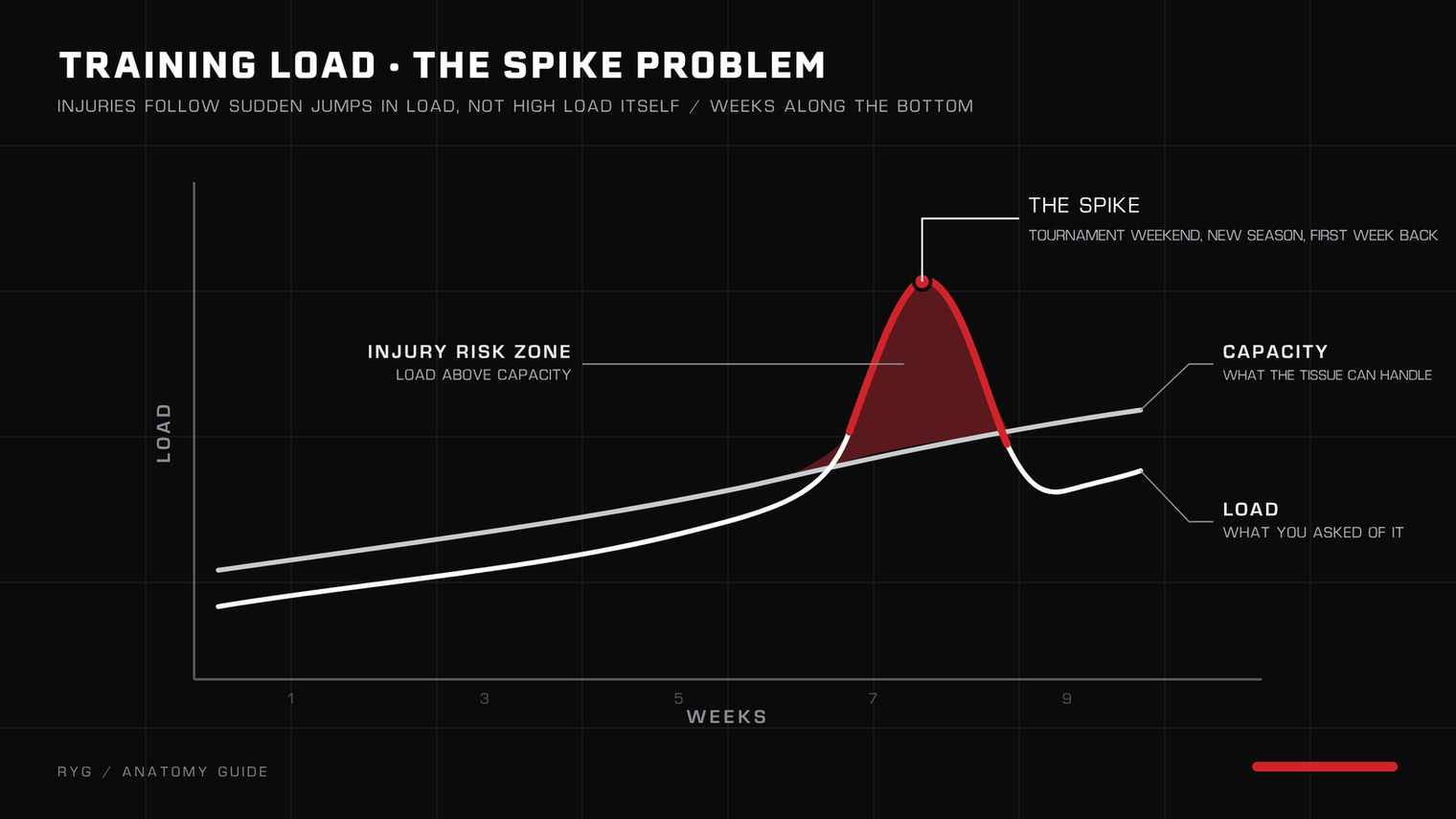
Almost every overuse injury in this blog series, jumper's knee, Achilles pain, back pain, shin and foot problems, shares one root cause. Jump volume climbed faster than the body could adapt. Pro and college programs now track jumps the way baseball tracks pitch counts, some with wearable sensors logging every takeoff, because the data keep showing the same thing. It is rarely the total amount of jumping that hurts an athlete. It is the sudden change.
What's actually going on
Tendons and bones adapt to load slowly, over weeks, while a tournament schedule can multiply load overnight, and injury lives in that gap. A club player's calendar is full of these spikes: tryout week, the first week of club after a school-season break, a three-day tournament after a light practice week, or the overlap month when school and club run together. Each spike asks the patellar tendon, the Achilles and the lower back for more than they adapted to during the quiet weeks before. The tissue does not fail on the day of the spike. It gets sore a week later, and by then the next tournament is on the calendar.
What the research says
- Non-contact injuries are rarely caused by training itself; they are caused by inappropriate programs, and excessive, rapid increases in load are responsible for a large share of soft-tissue injuries, while athletes who are used to high training loads get injured less than athletes who train less1.
- In elite youth volleyball, every extra set played per week raised the odds of jumper's knee 3.9-fold and every extra training hour raised it 1.7-fold, and match play was a stronger predictor than total training hours2.
- Weekly training jump counts in youth volleyball ranged from 50 to 666 for boys on the same team, with boys averaging about 36 jumps per hour in training and 62 per hour in matches, so two players doing the same practice can carry very different loads3.
- Novice runners who increased weekly distance by more than 30% had a higher rate of distance-related injuries such as patellofemoral pain and patellar tendinopathy than those who increased by less than 10%4.
- The 10% rule is not a hard line, though: a 13-week program built on it did not reduce injuries in 532 novice runners, 20.8% versus 20.3% on a standard plan5.
- In adolescent soccer players, a spike in that day's training load roughly doubled the odds of injury, and worse mood that day was an independent predictor as well6.
Heavier training volume, higher body weight and a higher countermovement jump are the factors most consistently linked with jumper's knee, meaning the most explosive athletes who train the most are the ones who get it7.
What we do about it
Parents do not need sensors to manage this. Rough counting works. Matches load a player much faster per hour than practice, and the research says sets per week is the number that matters most, so start by simply noticing which weeks are heavy and which are light, then smooth the transitions.
Practical rules we give families. Avoid doubling any week's jumping compared with the recent normal. Build back gradually after two or more weeks off rather than returning to full practice on day one. Treat a three-day tournament as a load spike and keep the following week lighter, not heavier. Communicate between school and club coaches during overlap months, because neither one sees the full weekly total. And listen to the morning-after signals, since a tendon that is stiffer every morning for a week is reporting a spike.
The other side of the equation is capacity. Athletes who are used to higher loads get hurt less, so a strength program in the off-season, heavy slow leg work and calf work, raises the ceiling the jump count has to stay under. In our evaluations we build a simple weekly load chart with the family and set the strength plan around it.
When to get it looked at
- Tendon pain below the kneecap or at the Achilles that is stiff every morning for more than a week after a volume jump.
- Low back pain in a growing athlete that is sharp with jump serving or hitting.
- Shin or foot pain that is now present with walking, not just jumping.
- A noticeable drop in jump height or a limp that persists beyond a day or two.
- A young athlete who is sore, tired and flat for more than a couple of weeks running.
Bottom line
Jump load is the common thread in volleyball's overuse injuries, and the research says the spike, not the total, does the damage, with sets per week the strongest predictor of jumper's knee in young players. Smooth the transitions, respect the week after a tournament, and build strength in the off-season so the body can carry more. If a tendon or a young back is already talking, get it assessed, in person, before the next tournament.
References
- Gabbett TJ. The training-injury prevention paradox: should athletes be training smarter and harder?. Br J Sports Med. 2016;50(5):273-280. PubMed
- Visnes H, Bahr R. Training volume and body composition as risk factors for developing jumper's knee among young elite volleyball players. Scand J Med Sci Sports. 2013;23(5):607-613. PubMed
- Bahr MA, Bahr R. Jump frequency may contribute to risk of jumper's knee: a study of interindividual and sex differences in a total of 11,943 jumps video recorded during training and matches in young elite volleyball players. Br J Sports Med. 2014;48(17):1322-1326. PubMed
- Nielsen RØ, Parner ET, Nohr EA, et al. Excessive progression in weekly running distance and risk of running-related injuries: an association which varies according to type of injury. J Orthop Sports Phys Ther. 2014;44(10):739-747. PubMed
- Buist I, Bredeweg SW, van Mechelen W, et al. No effect of a graded training program on the number of running-related injuries in novice runners: a randomized controlled trial. Am J Sports Med. 2008;36(1):33-39. PubMed
- Watson A, Brickson S, Brooks A, et al. Subjective well-being and training load predict in-season injury and illness risk in female youth soccer players. Br J Sports Med. 2017;51(3):194-199. PubMed
- Sprague AL, Smith AH, Knox P, et al. Modifiable risk factors for patellar tendinopathy in athletes: a systematic review and meta-analysis. Br J Sports Med. 2018;52(24):1575-1585. PubMed
This article is for education and does not replace an evaluation. If you're dealing with an active injury, see a licensed medical provider.