
Club Season Plus School Season: Protecting Volleyball Players Who Never Get an Off Season
 Volleyball
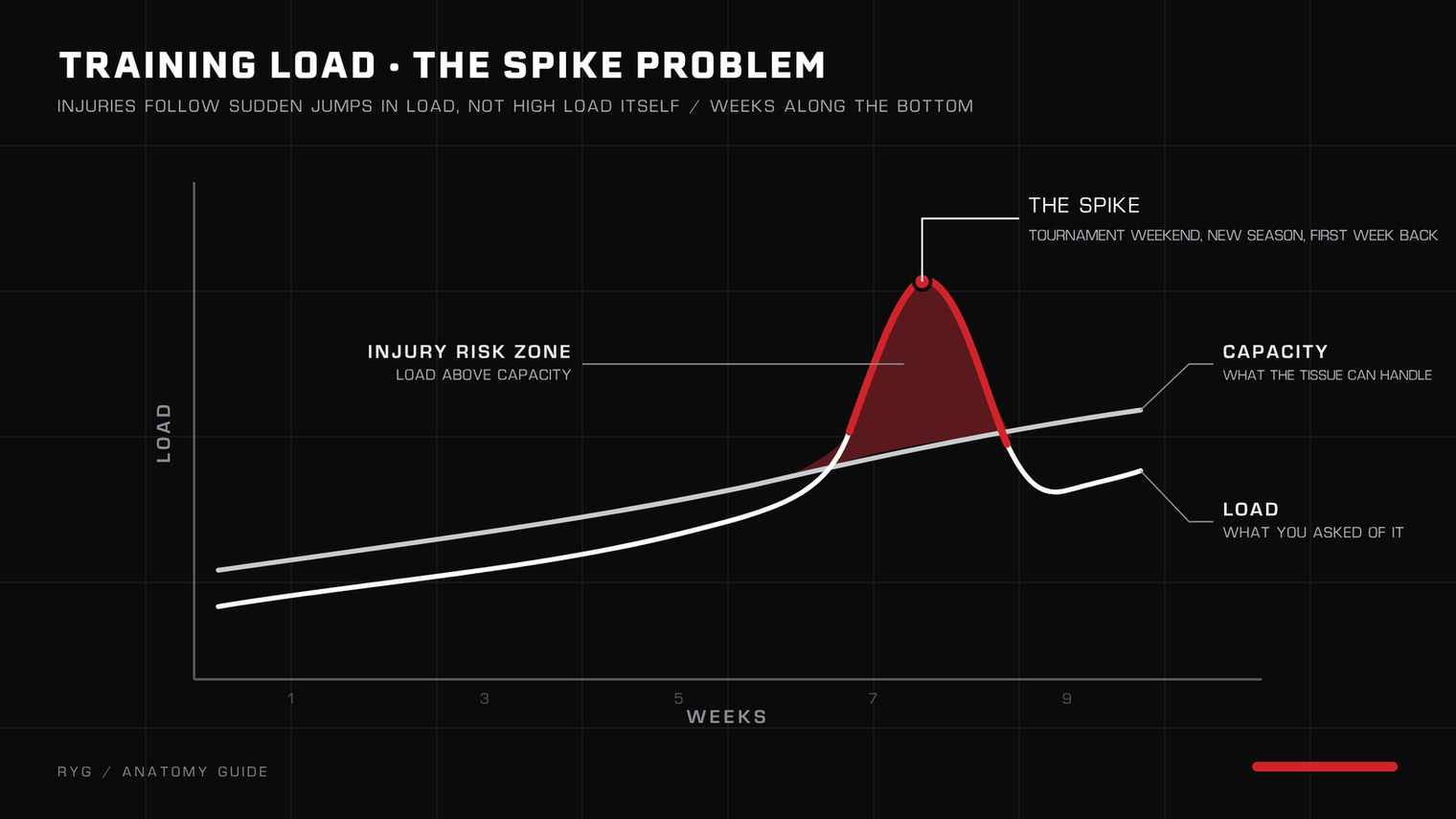
Here is a quiet math problem in youth volleyball. School season runs into tryouts, club season runs through spring into summer nationals, and camps fill whatever is left. Many players now compete or train ten to eleven months a year, and the overlap windows, when school and club or club and camps run simultaneously, are the heaviest weeks of all. It is no coincidence that we see waves of tendon pain and back pain in exactly those months.
Parents often assume more volleyball means a better volleyball player. The research on this is unusually direct, and some of the best of it was done on Wisconsin kids.
What's actually going on
Tissues strengthen during recovery, not during play. Bone in particular, which matters enormously for growing spines and shins, remodels on a cycle measured in weeks and needs periods of lower load to finish the job. Tendons are slower still. Young athletes are also growing, which means their tendons and growth areas are already handling extra stress just from getting taller. A year-round calendar never gives those tissues the quiet weeks they need to catch up, and the overlap months stack two coaches' plans on one body that neither coach sees in full. Add short sleep on school nights and the recovery side of the equation collapses.
What the research says
- Between 46% and 54% of all youth sports injuries are overuse injuries, and high school athletes who played a sport year-round reported 42% more overuse injuries than those who played three seasons or fewer, while training more than 16 hours per week was linked to higher injury risk1.
- In youth volleyball specifically, playing the sport more than 8 months of the year doubled the odds of an overuse injury, and high specialization raised it 2.3-fold; those associations were not seen in basketball or soccer in the same study2.
- Among 1,544 Wisconsin high school athletes, high competition volume doubled the odds of a prior lower-extremity injury and playing club sports raised it 1.5 times, and girls were more likely than boys to play at high volume, play club and be highly specialized3.
- A young athlete who spends more hours per week in organized sport than their age in years has about twice the odds of a serious overuse injury, and kids whose organized sport time outweighs free play by more than 2 to 1 have 1.9 times the odds4.
- Highly specialized young athletes have 1.8 times the risk of an overuse injury compared with kids who play multiple sports, and even moderate specialization raises risk 1.4-fold5.
- Fewer than 1 in 5 former NCAA athletes specialized before age 15, early specializers were no more likely to earn a scholarship, and they burned out at a higher rate6.
Sleep is part of the load equation: elite adolescent athletes who slept more than 8 hours on school nights had 61% lower odds of a new injury, and about 1 in 5 did not get the recommended amount on weekdays7. Overtraining is a whole-body problem that lowers performance, raises injury and illness risk, and disrupts hormonal, neurologic and psychological systems8.
What we do about it
Families have more control here than they think. A few principles go a long way. Keep weekly organized sport hours at or below the athlete's age in years. Protect at least one true rest day every week, no volleyball, no jumping sports. Build a two-to-four-week genuine break somewhere in the year, active and fun, just not volleyball, which keeps the single-sport total under the 8-month line the research flags.
During overlap months, communicate between coaches, because neither the school coach nor the club coach sees the athlete's full weekly total, and ask that the combined load not double in a week. Keep a second sport or unstructured play in the mix through middle school and early high school, since the specialization data and the scholarship data both point the same way.
On the recovery side, treat sleep as training: 8 or more hours on school nights, screens out of the bedroom. And use the off-season weeks for strength work, because athletes who are stronger carry the same jump volume with less injury. We help families map the calendar, find the overlap spikes and set a strength plan around them in our evaluations.
When to get it looked at
- Tendon or heel pain that is stiff every morning for more than a week.
- Low back pain in a growing athlete that is sharp with arching, serving or hitting.
- Shin, foot or hip pain that is now present with walking, not just playing.
- A persistent drop in performance, mood or energy, or an athlete who no longer wants to go to practice.
- Any pain that has been managed with rest and returned as soon as play resumed.
Bottom line
Year-round volleyball is a measurable injury risk, and the research is specific: more than 8 months a year doubles overuse injury odds in volleyball, more hours per week than the athlete's age doubles serious overuse injury odds, and early specialization does not improve the odds of a scholarship. A true off-season, a weekly rest day, enough sleep and off-season strength work are the levers. If your athlete already has a tendon or back that is complaining, get it assessed, in person, before the next season starts.
References
- DiFiori JP, Benjamin HJ, Brenner J, et al. Overuse injuries and burnout in youth sports: a position statement from the American Medical Society for Sports Medicine. Clin J Sport Med. 2014;24(1):3-20. PubMed
- Post EG, Biese KM, Schaefer DA, et al. Sport-Specific Associations of Specialization and Sex With Overuse Injury in Youth Athletes. Sports Health. 2020;12(1):36-42. PubMed
- Post EG, Bell DR, Trigsted SM, et al. Association of Competition Volume, Club Sports, and Sport Specialization With Sex and Lower Extremity Injury History in High School Athletes. Sports Health. 2017;9(6):518-523. PubMed
- Jayanthi NA, LaBella CR, Fischer D, et al. Sports-specialized intensive training and the risk of injury in young athletes: a clinical case-control study. Am J Sports Med. 2015;43(4):794-801. PubMed
- Bell DR, Post EG, Biese K, et al. Sport Specialization and Risk of Overuse Injuries: A Systematic Review With Meta-analysis. Pediatrics. 2018;142(3):e20180657. PubMed
- Rugg CM, Coughlan MJ, Li JN, et al. Early Sport Specialization Among Former National Collegiate Athletic Association Athletes: Trends, Scholarship Attainment, Injury, and Attrition. Am J Sports Med. 2021;49(4):1049-1058. PubMed
- von Rosen P, Frohm A, Kottorp A, et al. Too little sleep and an unhealthy diet could increase the risk of sustaining a new injury in adolescent elite athletes. Scand J Med Sci Sports. 2017;27(11):1364-1371. PubMed
- Brenner JS, Watson A, Council on Sports Medicine and Fitness. Overuse Injuries, Overtraining, and Burnout in Young Athletes. Pediatrics. 2024;153(2):e2023065129. PubMed
This article is for education and does not replace an evaluation. If you're dealing with an active injury, see a licensed medical provider.