
Turf Toe in Volleyball: The Big Toe Sprain That Makes Every Jump Hurt
 Volleyball
Turf toe is a sprain of the joint at the base of the big toe, usually from the toe getting bent backward past its comfortable limit. In volleyball it happens on hard push-offs, a toe jammed into the floor during a lunge or dive, or another player landing on the back of your foot at the net while your toe is planted. It sounds minor until you learn what that joint does. The big toe is the last point of contact on every approach jump, and it has to bend back forcefully to let you push off.
That is why a small sprain causes outsized trouble, and why getting the grade right matters more than with most sprains.
What's actually going on
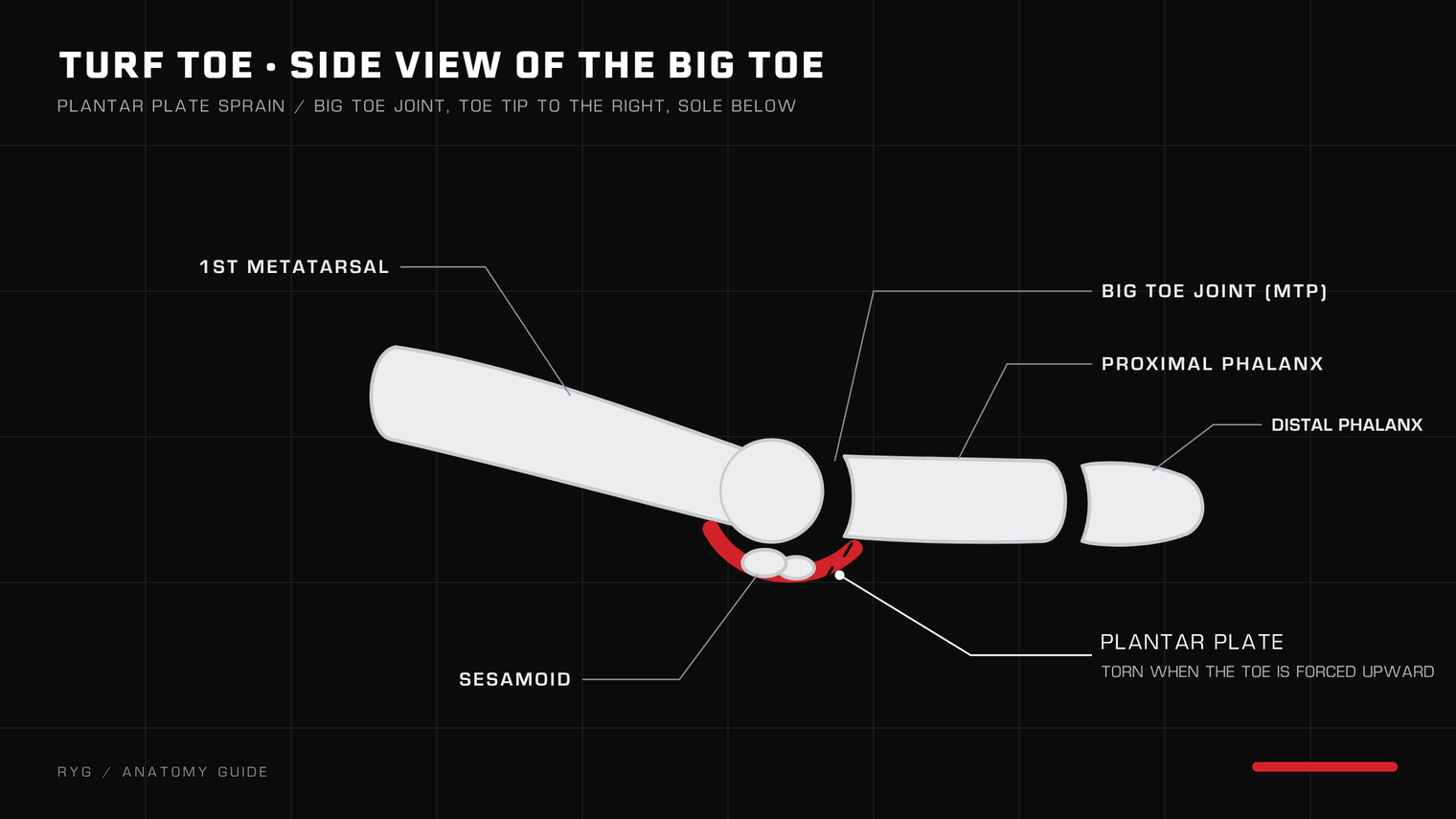
Under the big toe joint sits a thick ligament-and-capsule structure, the plantar plate, with two tiny bones, the sesamoids, embedded in it. When the toe is forced back, that structure stretches or tears. Every approach jump then rolls your weight over the injured joint and bends the toe back, exactly the motion that is hurt. Athletes who try to play through it start jumping off the outside of the foot to avoid the pain, which kills jump height and hands new problems to the ankle and knee. The grade of the sprain, from a stretch to a partial tear to a complete rupture, is what decides whether this is a one-week nuisance or a months-long rehab.
What the research says
- Turf toe is a hyperextension injury of the big toe joint in 85% of cases, and in the original professional football series 83% of players were first injured on artificial turf1.
- Recovery depends on grade: a grade I sprain returns as tolerated, a grade II partial tear takes about 2 weeks, and a grade III complete tear needs at least 10 to 16 weeks, and some complete ruptures need surgical repair2.
- In college football, turf toe happened nearly 14 times more often in games than practice, cost an average of 10 days, and fewer than 2% required surgery3.
- A past turf toe left the big toe joint with about 8 degrees less dorsiflexion (40.6 versus 48.4 degrees) and higher peak pressure under the toe, which is why restoring motion and push-off strength matters4.
- Professional players who returned from turf toe performed at the same level as uninjured peers over the next 2 seasons, even though the injury cost an average of about 5 weeks5.
- Players who needed surgical repair of a complete turf toe injury missed an average of 16.5 weeks but had excellent outcomes about 2 years later, with pain under 1 out of 106.
One reminder that not all big toe pain is turf toe: symptomatic arthritis of the big toe joint affects 7.8% of adults over 50 and most of them report disabling foot symptoms, so stiffness without an injury gets a different conversation7.
What we do about it
Management depends on severity, so the exam and sometimes an X-ray come first to grade the sprain and check the sesamoids. Protection is the underrated piece. A stiff-soled shoe or a thin carbon insert that limits how far the toe bends lets the athlete stay active while the ligaments heal, and taping the toe to block extension helps in the early weeks.
Rehab then rebuilds the toe's bend gradually, because the research shows a healed turf toe tends to leave the joint stiffer, and a stiff big toe shifts pressure and changes push-off for years. Gentle motion starts as soon as the grade allows, then big toe strengthening with towel scrunches and resisted toe press, calf and foot strength, and single-leg balance.
The last phase retrains push-off: heel raises through the big toe, then pogo hops, then approach jumps with full toe extension under load, with the insert phased out as the joint tolerates it. Players in This is the progression we run in the clinic, with a test at every phase before you move on.
When to get it looked at
- A big toe that cannot push off at all, or a joint that feels loose or unstable.
- Significant swelling and bruising under the toe within hours, or inability to bear weight through the forefoot.
- A visible deformity, or the toe sitting in an abnormal position.
- Pain under the ball of the foot that persists for more than two weeks, which can mean a sesamoid injury.
- Any turf toe that is not clearly improving after two weeks of protection.
Bottom line
Turf toe in volleyball is a small joint with a big job, and the research says the grade sets the timeline: days for a stretch, weeks for a partial tear, months for a complete one. Protection that limits toe bend lets most players stay active while it heals, and restoring motion and push-off strength afterward is what prevents a permanently stiff toe. If the toe feels loose or cannot push off, get it graded now, in person.
References
- Rodeo SA, O'Brien S, Warren RF, et al. Turf-toe: an analysis of metatarsophalangeal joint sprains in professional football players. Am J Sports Med. 1990;18(3):280-285. PubMed
- McCormick JJ, Anderson RB. Turf toe: anatomy, diagnosis, and treatment. Sports Health. 2010;2(6):487-494. PubMed
- George E, Harris AH, Dragoo JL, et al. Incidence and risk factors for turf toe injuries in intercollegiate football: data from the national collegiate athletic association injury surveillance system. Foot Ankle Int. 2014;35(2):108-115. PubMed
- Brophy RH, Gamradt SC, Ellis SJ, et al. Effect of turf toe on foot contact pressures in professional American football players. Foot Ankle Int. 2009;30(5):405-409. PubMed
- Tran A, Kappa J, Smith E, et al. The Effect of Turf Toe Injuries on Player Performance in the National Football League. Iowa Orthop J. 2019;39(2):35-39. PubMed
- Smith K, Waldrop N. Operative Outcomes of Grade 3 Turf Toe Injuries in Competitive Football Players. Foot Ankle Int. 2018;39(9):1076-1081. PubMed
- Roddy E, Thomas MJ, Marshall M, et al. The population prevalence of symptomatic radiographic foot osteoarthritis in community-dwelling older adults: cross-sectional findings from the clinical assessment study of the foot. Ann Rheum Dis. 2015;74(1):156-163. PubMed
Our son broke his ankle in a hockey game. With his goal of being ready for spring TO’s we were on the hunt for a PT that knew the game and expectations of a hockey player. We were referred to Alex by a coach.
After meeting with/ Alex our son , wife and I were 100% this is the right guy to help our son. Alex put multiple pt plans together along with on ice plans to reintroduce skating. Most of all our son trusts and listens to Alex about the recovery process. Our son is ahead of schedule!
Pretty much the best experience we’ve ever had with a doctor.
Thank you
Lessner’s
Had an amazing time this summer rehabbing my ankle with Dr. Shuchuk. He is very knowledgeable in any area of PT and always willing and able to help any ailment you have! I thought my ankle could never be fixed, but after getting on a plan and staying consistent I have regained my game!
Thanks Shu
This article is for education and does not replace an evaluation. If you're dealing with an active injury, see a licensed medical provider.